This is the 239th edition of the Classical Astronomy Update, an email newsletter especially for Christian
homeschool families (though everyone is welcome!) Please feel free to share with any interested friends.
The high hills are a refuge for the wild goats; and the rocks for the conies. He appointed the moon for seasons: the sun
knoweth his going down. Thou makest darkness, and it is night: wherein all the beasts of the forest do creep forth. --
Psalm 104:18-20 IN THIS UPDATE Rambles re Space Stuff Conjunctions and Timekeeping Hi Friends, Welp, as mentioned in previous newsletters, since last summer I planned to
participate in The Heartland Self-Reliance Conference this weekend in Millersburg, Ohio. What a shock and disappointment that this event was abruptly cancelled shortly beforehand. Thanks to everyone who intended to attend, I apologize for any inconvenience. Hoping to have other opportunities in the future to give presentations about the ancient traditions of telling time and finding
direction from the Sun, Moon, stars and planets. Maybe we'll have another chance? Notice from the header above that this the 239th edition of this newsletter since 2002. It's lately become very common to see such numbering, like "Zohran Mamdani is 112th Mayor of New York City" and such. I
don't recall seeing that in the past, certainly not as prevalent as today. Thanks to everyone who has followed the Update all these years through many of those editions. By the way, I posted plans on the website for creating a Backyard Compass. This is an activity from our Signs & Seasons astronomy curriculum, also included in the Field Journal workbook. Other websites have bootlegged my Backyard Compass instructions without even giving a link back. So since my content has been appropriated anyway, hope this helps more
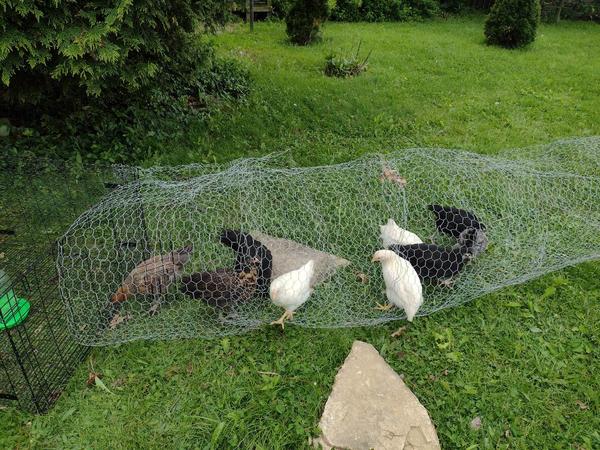
people to find direction from the sky, and in doing so, learn the methods of telling time by the Sun, Moon and stars. Chicken Report In response to the last newsletter, many readers wrote positive and encouraging emails about us embarking upon our chicken odyssey. We're now officially "urban homesteaders"! We're learning so much about the birds
themselves but also the long human tradition of keeping chickens as a part of self-sufficiency, something greatly lacking in today's generation. Moreover, I'm gaining insights into how self-sufficency relates to our American freedom. We think we're free today but not like our ancestors who lived close to God's Creation, who fed themselves from their own
chickens and observed the passing seasons under a pristine night sky. Our freedom is imperiled if we depend on the grocery store for our survival. What if one day the delivery truck doesn't make it? When I was a kid, the old timers born in the 19th century all kept gardens and shared their homegrown produce with their friends and family. I used to see the abandoned chicken coops of that departed generation in city neighborhoods. With food security becoming an issue,
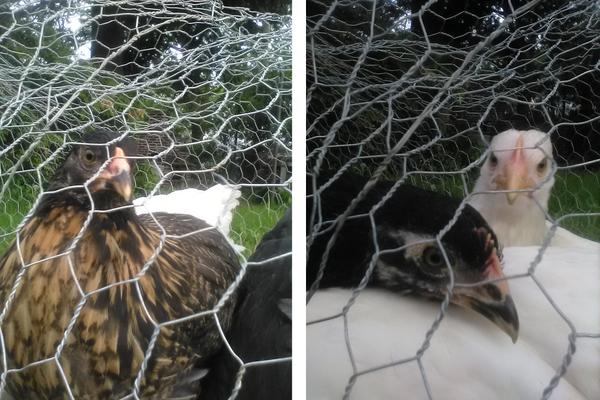
our generation would do well to revive that tradition. I'm at least making a start in my old age! Anyway, I'm AMAZED at how quickly those fuzzy little chicks have turned in BIG birds! Yikes! I can't believe their deadly talons! Like a velociraptor or something! (Rookie city slicker here!) But these girls are absolutely adorable! We have three varieties, which
Grammie ("The Chicken Mom") knows by name -- Americana, Australorp and some other kind of white bird. I save all that trouble by just calling them Blondes. Brunettes and Redheads. They are so fun to watch and interact with. It breaks heart my to think of how such bright, curious, sensitive creatures could be kept in today's food factory "chicken prisons." What a revelation, wish we would've done this decades ago, especially when our kids were small. I've been scrambling to build a suitable chicken coop (i.e., "bird cage") but these birdbrains are getting noticeably bigger from week to week! They're quickly outgrowing their temporary space! Sometime this summer we can hope to have of our own healthy eggs for ourselves and to bless our friends, family and neighbors. Thanks to everyone who has expressed interest and
support, I encourage you all to get some birds of our own, what a rewarding experience thus far. For more information about topics from Classical Astronomy discussed in this newsletter, please check out a homeschool astronomy curriculum (but popular with adult readers too!) Visit our archive of previous editions of the Classical Astronomy Update newsletters, going back to
2007. SOCIAL MEDIA ***** But first, a couple of quick things... Midnight Sun Here's a cool video showing the scene in Utqiagvik, Alaska (formerly Barrow), the northernmost settlement in the USA, which has entered a stretch of 84 consecutive days without a sunset. The vid includes an interview with Asisaun Toovak, mayor of this
town, 320 miles north of the Arctic Circle. This is a place I've always wanted to visit, and would have liked to live for a year to experience a complete annual cycle. Ben Franklin Quote I got this great quote by Ben Franklin from The Cranky Arborist™ (follow him on Tik Tok). This is from Poor Richard's Almanack for 1748. This illustrates how the subject of geocentrism (not to mention flat earth-ism) was dismissed in pre-industrial Colonial America nearly three centuries ago.... "On the 19th of this Month, Anno 1493, was born the famous Astronomer
Copernicus, to whom we owe the Invention, or rather the Revival (it being taught by Pythagoras near 2000 Years before) of that now generally receiv’d System of the World which bears his Name, and supposes the Sun in the Center, this Earth a Planet revolving round it in 365 Days, 6 Hours, &c. and that Day and Night are caused by the Turning of the Earth on its own Axis once round in 24 h. &c. The Ptolomean System, which prevail’d before Copernicus, suppos’d the Earth to be fix’d, and that the Sun went round it daily. Mr. Whiston, a modern Astronomer, says, the sun is 230,000 times bigger than the Earth, and 81 Millions of Miles distant from it: That vast Body must then have mov’d more than 480 Millions of Miles in 24 h. A prodigious Journey round this little Spot! How much more natural is Copernicus’s Scheme! Ptolomy
is compar’d to a whimsical Cook, who, instead of Turning his Meat in Roasting, should fix That, and contrive to have his whole Fire, Kitchen and all, whirling continually round it. February. XII Month."
Rambles re Space Stuff I'm always explaining that "Classical" Astronomy is not the usual approach to astronomy put out in the mainstream media, but is rather the forgotten traditions of observing the sky for telling time and finding direction as had been practiced through all pre-industrial history. It doesn't matter how often I say it. I'm constantly bombarded with questions and remarks about mainstream "modern" astronomy.
I'll get an email from a friend like, "here's an article about black holes since you're into NASA and astrology and all that other space stuff." Ugh. Since it's my "density" to be the "friendly neighborhood astro-space-science dweeb," here's some remarks about recent "space" topics in the news. Artemis II By now this subject is SOOO last month, but I hope we all agree that the most recent moonshot was an inspiring event. Having spent decades of my life regaling my juniors with recollections of Apollo from the 1960s and 70s, I can now finally say that anyone who followed Artemis II witnessed an authentic NASA Moon mission, with similar events and benchmarks as the bygone missions over a half-century ago. So you no longer need endure
Grampa Boomer's wearisome lectures about "the good old days" when NASA used to send human astronauts to the Moon, you now have new stories of your own. The feel and the excitement of a Moon mission was captured by the Artemis coverage, though the public response was greatly subdued compared to the wild enthusiasm of the 1960s. But the full color digital video
and sound quality today was immensely superior to the old static-y, grainy black and white coverage of Apollo. And the Artemis astronauts were very much "Gen Xers in space" compared to their Apollo predecessors. They wore their hearts on their sleeves, and were very open and candid about sharing their descriptions of their experiences and their emotional reactions, including their fears, which was very refreshing and endearing. If you asked the old Apollo guys like Neil
Armstrong or Jim Lovell "how are you feeling right now," you'd've heard a concise, confident assertion that "we're GO for this mission" and that would have been that. Those "Right Stuff" guys got to that place by being Vietnam-era fighter pilots, selected to be cool as cucumbers under unprecedented pressures. I'm sure we all agree that astronaut Victor Glover was the
breakout sensation of the Artemis II mission. He was so open with sharing his Christian faith at every opportunity, in his impromptu Easter message, echoing Apollo 8's Christmas reading from Genesis, and his message before "Earthset" and "loss of signal" (LOS) behind the Moon. Here's a Facebook clip of Victor sharing his faith upon returning to Earth. As could be expected, the Apollo deniers were up to their old tricks, finding every little hint and clue to presumably prove that the Artemis mission was fake. Today, as back then, such people came across as
cranks. I think most viewers believed the mission was genuine and did not find it to be a fake. For my own part, I can't prove whether Apollo or Artemis were real, but it suits me to believe they both actually happened. I'd like to hope in such monumental human achievements. So I thus hope this recent mission finally dispels the denialism for the large number of people. UFO/UAP Disclosures I'm also getting pinged about the recent government release of material about UFOs and UAPs. My general opinion is that everything we're told by government or media is a lie, it's all some grand puppet show for the benefit of the general public, for whatever nefarious purposes. While on one hand, as mentioned above, I choose to believe that
Apollo/Artemis really happened, I'm highly dubious of these UFO/UAP disclosures. For one thing, I've spent uncountable hours looking at the sky over the last four decades and I've seen LOTS of things that I can't explain. The more you look, the more weird stuff you see. Like Yogi Berra said, "You can observe a lot by watching." I'd encourage everyone to do the same and let me know what you see. Most people today spend very little time looking at the sky and jump to
all sorts of cockamamie conclusions on such occasions as they spot an anomaly in the sky. But while these newly released videos show weird things streaking by and moving in an unnatural manner, there is nothing to suggest that these are "proof of alien visitations." Do I believe in UFOs? Sure, why not? I personally have seen a lot of "flying objects" that
were "unidentified." Same for UAPs. I've also seen "aerial phenomena" that are "unexplained." I wouldn't be surprised if there are still uncatalogued atmospheric phenomena. In centuries past, the edges of the known world were marked on maps with "here be dragons" reflecting the fears, legends and imaginations of that era. In my opinion reports of alien visitations are probably just the modern day equivalent of the mythical figures of the past. Congresswoman Anna Paulina Luna (aka "Capitol Barbie") last summer reported that "lawmakers have evidence of ‘interdimensional
beings.’" So what's that supposed to mean? Strikes me as VERY hinky. But the "powers that be" have brazenly lied to our faces in recent years, as with covid, for example. Just this week the covid whisteblower testimony before the Senate corroborated a bunch of stuff we were told five years ago. But is that itself to be believed or is it a just double head fake, yet another psyop within a psyop? It's all become a house of mirrors. With all the AI fakery filling the video space lately, any further disclosures of "aliens" or
other such creatures will have to be backed up with a "Lincoln funeral train" presenting any purported dead bodies in person before I'll even consider believing anything. In the meantime, I'll stick with "Koheleth" (aka "the Preacher") who wrote: Let us hear the conclusion of the whole matter: Fear God, and keep his commandments: for this is the whole duty of
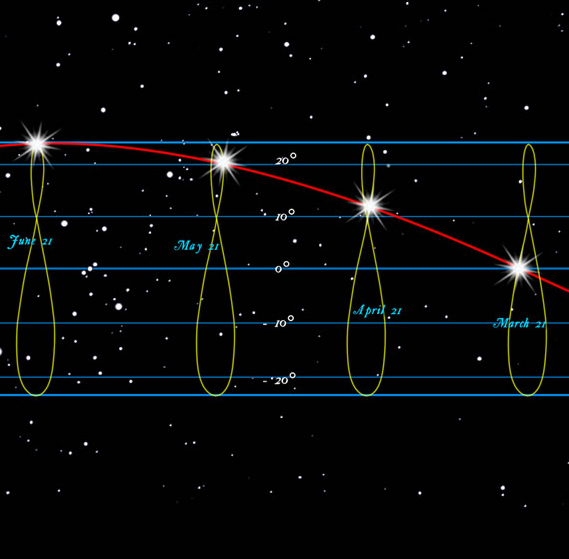
man. -- Eccl. 12:13 Conjunctions and Timekeeping As reported in recent newsletters, the Sun has been moving north in declination over the course of the spring, due to the orbital motion of the Earth.
The Sun crossed the celestial equator (declination zero degrees) on March 21, the vernal equinox (or first day of spring). It reached a declination of about 12 degrees north by April 21. As a result, the places of sunrise and sunset have shifted north, resulting in the longer daylight that we all observe. The Sun will reach a declination of 20 degrees north this week on May 21. The length of daylight will then only increase a small amount
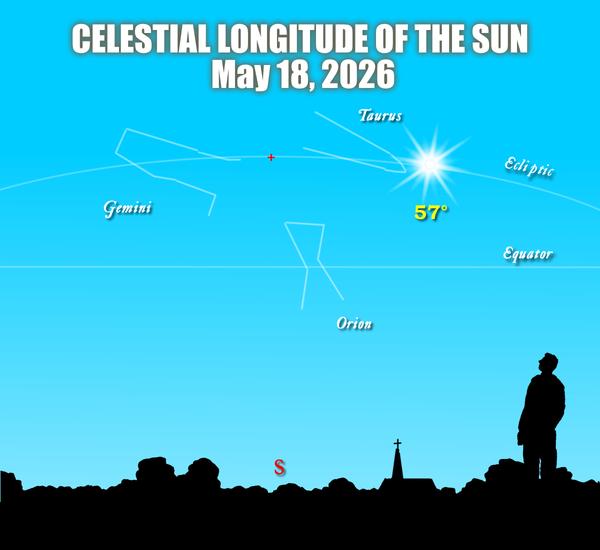
over the next month until the summer solstice on June 21, when the Sun's declination will be 23.5 degrees north. The Sun has been "ascending the seasonal hill" and "levels off" as it approaches the solstice. On May 18, the celestial longitude of the Sun will be 57 degrees. This is a measurement of the position of the Sun along the ecliptic, the path of the apparent solar movement through the constellations due to the Earth's orbital motion. By this date, the Sun is aligned
with the Pleiades star cluster in the constellation Taurus, a prominent feature in the evening sky during the winter. The stars of Taurus are thus invisible during May since they are hidden behind the bright glare of the Sun and the daytime blue sky. The Sun appears to move along the ecliptic about one degree per day, which is the same as
two solar diameters per day. So the Sun will be at about 60 degrees on May 21. Thus, we see that the Sun moves about 30 degrees per month (or 360 degees in 12 months). So two months ago on the vernal equinox, the Sun's celestial longitude was zero degrees. And a month from now on the summer solstice, the Sun's celestial longitude will be 90 degrees. By that time the Sun will be aligned with the constellation Gemini. On the evening of May 18, you can see the twin stars of Gemini hanging above the western horizon during nightfall after sunset. This is a sure farmer's "sign" in the sky that it is the month of May, as you can only see this configuration at sunset in the currrent month. Since Orion is
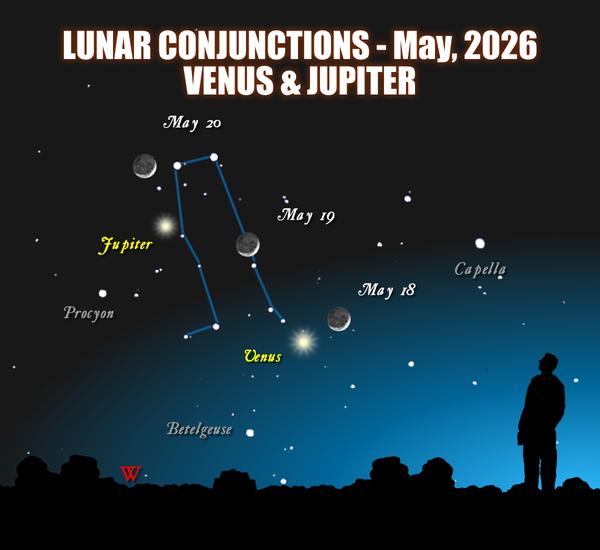
near Gemini, that constellation will have mostly vanished from the evening sky. But if you have a clear, flat horizon, you might still spy Betelgeuse, the brightest star in Orion, hovering low in the twilight sky. Venus has lately become a prominent object in the evening sky. Take a look after sunset on Monday, May 18, 2026 to
see the waxing crescent Moon as it aligns in its monthly lunar-planetary conjunction with Venus. Also go outside on the following evenings, May 19 and 20, to see the waxing Moon pass the bright planet Jupiter. Venus and Jupiter are the brightest celestial objects in the sky after the Sun and Moon so you'll have no problem spotting these awe-inspiring alignments. Also notice the bright stars Capella, to the right (north) of this scene, and also Procyon to the left (south). Capella and Procyon are about 409 degrees apart, a considerable distance in the sky, so don't be misled by the small appearance of the image below. For many years this newsletter has reported on such upcoming conjunctions. These events are calculated in advance by professional astronomers, following the reliable clockwork of the heavens, the celestial mechanics of the Earth, Moon and the solar system bodies. However, while we can use
these calculated events to anticipate sightings on a given date, such sightings can also be used to establish the date of such a sighting if the current date is unknown. Such conjunctions are recorded in astronomical almanacks, still published today as they were in Colonial America nearly 400 years ago. Suppose you're living on a farm 20 miles outside of
Boston in Colonial Massachusetts in A.D. 1650, an all-day ride in your wagon. Or suppose your farm is 20 miles from Philadelphia in A.D. 1750. What happens if you lose track of the date? You can't very well ride into town to ask someone. Those of us of a certain age will recall when such questions were commonplace before the advent of smartphones and accurate GPS time at your fingertips. You'd ask a family member or coworker "what's today's date?" But if
you're living on a pre-industrial farm in Colonial America with no smartphone and no nearby neighbors, how did you determine the date? This information was essential for knowing the times of planting and harvest. The survival of one's family depended on it. Every "Old Farmer" had a copy of the annual astronomical almanack. In fact, there were three
publications owned by every colonial family -- the Holy Bible, Pilgrim's Progress, and the annual almanack. The latter was used for finding the time of day, the day of the month and the month of the year. So if the Old Farmer lost track of the date, he would simply look in his almanack, see that, say, a conjunction of the Moon and Venus was
predicted for the evening of May 18, and the sighting confirmed for him the actual date. All this without a smartphone! I encourage everyone to have an almanack handy and consult them frequently to find the dates of conjunctions. A list of currently published almanacks is linked to the Classical Astronomy site. You can also find one or more of these publications at your local drug store or supermarket. After the Venus and
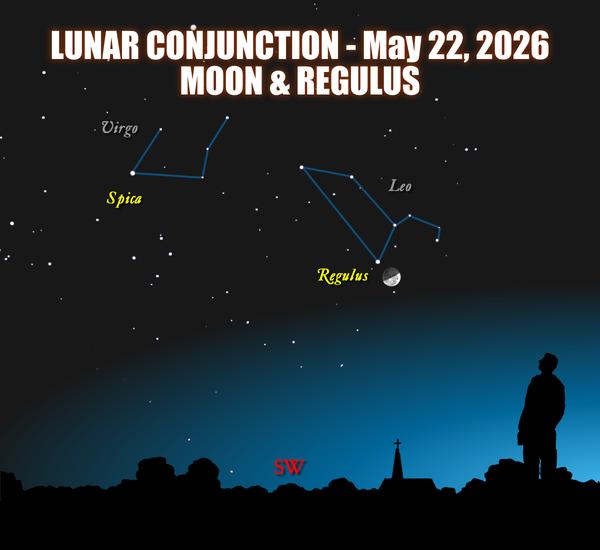
Jupiter alignments, keep an eye on the waxing Moon throughout the week as it approaches the bright star Regulus in the constellation Leo. These two will align in a lunar-stellar conjunction on the evening of Friday, May 22, when the Moon is at First Quarter. Over the coming month, we can observe the Twin Stars of Gemini sinking closer toward the place of the sunset, as the Sun advances toward that position. In fact, this is also a seasonal farmer's "sign" that the longest days of summer are approaching. If you have a clear, flat horizon,
you can follow the disappearance for the season of Betelgeuse, as it will soon vanish below the western horizon after sunset. Also note Capella and Procyon as they draw lower toward the sunset over the coming weeks, vanishing themselves with the onset of summer. Follow the dance of the planets in May and June as Venus and Jupiter draw closer, Jupiter descending and
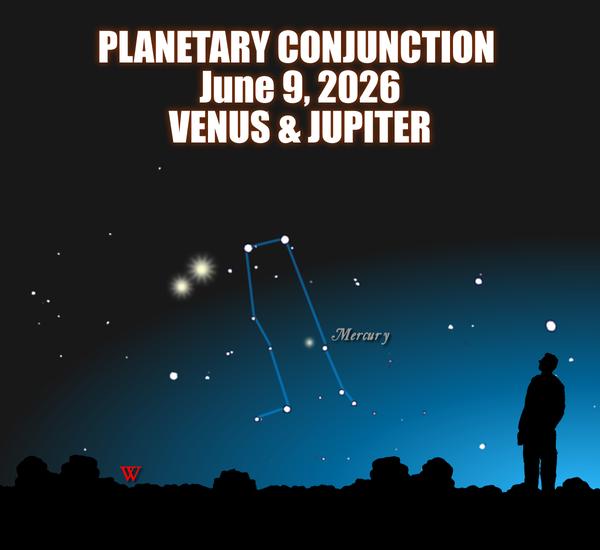
Venus ascending as they follow their own cycles. These two bright bodies will align in a brilliant planetary conjunction on the evening of Tuesday, June 9, 2026, forming a nearly straight line with the Twin Stars of Gemini. This configuration occurs every couple years and is always a beautiful sight in in the evening sky. If your horizon is clear and flat, you might even catch a peek of the elusive planet Mercury as it aligns with Gemini. But Mercury
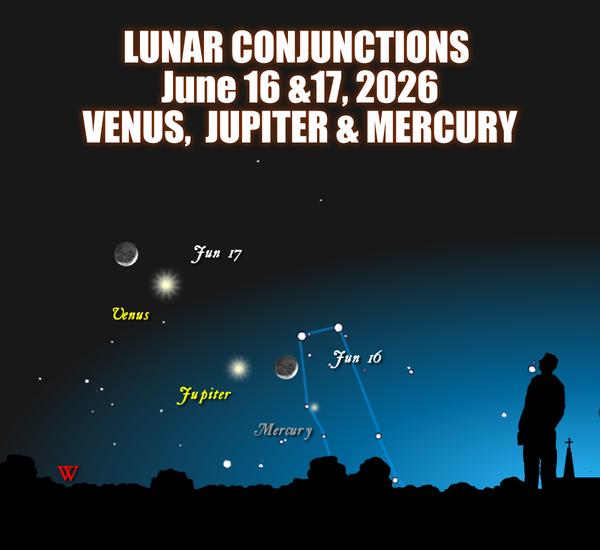
is a tricky object to spot so don't feel bad if you can't pick it out. And sure enough, as happens every month, the next lunation cycle will bring the waxing crescent Moon back around to these planets in June. The Moon will appear between Jupiter and Mercury on the evening of Tuesday, June 16, and will have passed Venus by the next evening, Wednesday, June
17. As you might expect, the Moon will also align with Regulus on the evening of Friday, June 19, and that will be an occultation visible from the USA. Who knows, maybe we'll sneak out another newsletter on that subject before that date? But if not, you might find more information in
the almanack! Till next time, God bless and clear skies, - jay The Ryan Family Cleveland, Ohio, USA When I consider thy heavens, the work of thy fingers, the moon and the stars, which thou hast ordained, what is man that
thou art mindful of him? and the son of man, that thou visitest him? - Psalm 8:3-4, a Psalm of David
|
|
|
|