This is the Classical Astronomy Update, an email newsletter especially for Christian homeschool families
(though everyone is welcome!) Please feel free to share this with any interested friends.
He is not here: for he is risen.... -- Matthew 28:6 IN
THIS UPDATE "Resurrection Sunday"? Return to the Moon Hi Friends, Just a quickie newsletter to "rerun" a couple items from previous editions. Hope you all have (or had) a blessed and joyous Pascha! The Heartland Self-Reliance Conference (THSRC) Just another reminder that I'll be speaking at THSRC on May 15-16, 2026 in Millersburg, Ohio, giving presentations on natural methods of telling time and finding direction from the Sun, Moon and stars. Please let me know if you plan to attend this conference. Anyone? ...Anyone??? ......Buehler????? Health Corner -- Chickens In today’s America we’re absolutely swimming in an ocean of
chemicals. People think I’m nuts for saying that, but when you add up all the food additives, chemicals in the air and water, lotions and potions, cleaning chemicals, industrial products and dumb unnecessary stuff like fragrance and room freshener, just about everyone is getting a daily dose of chemicals that never existed in nature, that were never encountered by our ancestors in all human history. Many of these fake chemicals are “generally regarded as safe” (GRAS) by the corporations feeding them to us, with no test data to show whether any of it is safe or harmful one way or another. And there are so many chemicals with actual test data and known health effects (as reported on MSDSs- “Material Safety Data Sheets”). Many people are exposed to further toxicity to such substances in their jobs where the workers blow off wearing
the gloves, masks or other PPE. So tell me that none of this makes a difference, especially when so many people are sick and dying from “unknown” causes. But when we do get sick (probably from a lifetime of exposure to all these fake chemicals), the prescription of modern "medicine" is MORE fake chemicals in the form of pharma. It's a miracle that most of us are as healthy as we are under the circumstances, and live as long as we do in spite of Big Pharma. So anyway, Grammie (Mrs. Ryan) has taken the proactive step of adopting nine "grandchickens." This is a better plan than the typical "empty nester" strategy of doting on a yappy little "foo foo" dog. And while little Foo Foo is only good for biting the mailman's ankles, the grandchickens will produce a tangible product for our consumption. Just look at these
adorable baby girls! As I always say, the chicken is ample proof of the existence of a loving Creator Father God. There is not a creature more suited for human dietary needs, and humans could not conceive or genetically engineer a more perfect creature. Chickens have a physiology whereby 50% of their metabolism is geared for DAILY OVULATION
(yikes!) and each day lay an egg about the proportional size of a cataloupe compared to a human. This egg is highly digestible for humans and contains just about every imaginable nutrient for our bodies. The most wonderful and amazing part is that the chicken herself is completely unharmed by this remarkable process. She'll lay that egg every day whether or not a human comes along to collect and eat it. For a while now we've been buying eggs from church friends and I've become totally spoiled. These healthy eggs have such rich yolks, so thick and colorful compared to the sickly, runny eggs from the store. Last year I read the disgusting, heartbreaking account in Joel Salatin's book, The Marvellous Pigness of
Pigs of how chickens are shot up with chemicals and tormented in the modern factory industrial food system. Hope you'll all read that book too, it's a total eye-opener. Looking forward to having some of our own healthy eggs for ourselves and to bless our friends, family and neighbors. For more information about topics from Classical Astronomy discussed in this newsletter, please check out a homeschool astronomy curriculum (but popular with adult readers too!) Visit our archive of previous editions of the Classical Astronomy Update newsletters, going back to
2007. SOCIAL MEDIA ***** "Resurrection Sunday"? This year I've noticed a big uptick, in media and from individuals, of Christians using the term "Resurrection Sunday" in place of "Easter." This is probably due
to the old, old rumor in evangelical churches that the ancient Christian Feast of the Resurrection is somehow based on paganism, with cultural traditions of eggs and bunnies cited as proof. This allegation is false, plain and simple. The early church celebrated the LORD's resurrection from the time of the Apostles. While some believers today are
sabbatarians who hold that we should rather worship on Saturday, the notion of Sunday worship has basis in the Gospels: And when the sabbath was past, Mary Magdalene, and Mary the mother of James, and Salome, had bought sweet spices, that they might come and anoint him. And very early in the morning the first day of the week, they came unto
the sepulchre at the rising of the sun. And they said among themselves, Who shall roll us away the stone from the door of the sepulchre? And when they looked, they saw that the stone was rolled away: for it was very great. And entering into the sepulchre, they saw a young man sitting on the right side, clothed in a long white garment; and they were affrighted. And he saith unto them, Be not affrighted: Ye seek Jesus of Nazareth, which was crucified: he is
risen; he is not here: behold the place where they laid him. - Mark 16:1-6 So everytime Christians gather to worship on Sunday, it is commemoration of the LORD's resurrection on that day of the week. Historically, Sunday worship would be at sunrise, rather the leisurely hours of today's churches. So each Sunday is therefore regarded as a "Little Easter,"
separate from the special Feast celebrated in the spring. There is other Scriptural evidence that Sunday was observed by the early church, like this indirect reference from the Apostle John: I was in the Spirit on the Lord's day, and heard behind me a great voice, as of a trumpet.... -- Revelation 1:10 This term, The LORD's Day, is taken directly from the Greek -- τη κυριακη ημερα ("tay kyriakay hemera") -- that literally means "Day of the LORD." While no specific Sunday worship practices are set forth in Scripture, we still possess the testimony of Ignatius of Antioch, a very early church father and martyr, who was the colleague and immediate successor of the Apostle John.
Ignatius wrote: Let every one of you keep the Sabbath after a spiritual manner, rejoicing in meditation on the law, not in relaxation of the body, admiring the workmanship of God, and not eating things prepared the day before, nor using lukewarm drinks, and walking within a prescribed space, nor finding delight in dancing and plaudits which have no sense in
them. And after the observance of the Sabbath, let every friend of Christ keep the Lord's Day as a festival, the resurrection-day, the queen and chief of all the days. So we see from Ignatius evidence that the earliest church (at least under his direction) kept both the Jewish Sabbath and the LORD's Day. The divergence of Christians from
Sabbath-keeping is explained elsewhere. But the point here is that every Sunday is "Resurrection Sunday" and that it is redundant and ahistorical to single out only the springtime Feast as being a Sunday somehow distinct from all others. So the main objection boils down to the name "Easter" and the purported similarities to the pagan goddesses Ishtar or Astoreth.
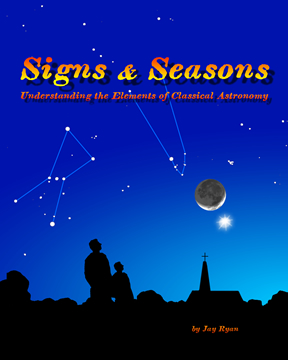
As explained in detail in the Epilogue of our Signs & Seasons curriculum, the name "Easter" is strictly an artifact of the English language, derived from a similar name in German and having a common Germanic root.
The Greek word for the springtime Feast of the Resurrection is pascha (πασχα), pronounced "pah-ska," which is the Greek equivalent of the Hebrew word pesach, (פסח) for Passover. The King James translates Pascha as "Easter" in the verse below while other contemporary English versions render it as "Passover": And when
he had apprehended him, he put him in prison, and delivered him to four quaternions of soldiers to keep him; intending after Easter to bring him forth to the people. - Acts 12:4 (KJV) And when he had seized him, he put him in prison, delivering him over to four squads of soldiers to guard him, intending after the Passover to bring
him out to the people. -- Acts 12:4 (ESV) As further explained in detail in the Epilogue of our Signs & Seasons curriculum, nearly all other European languages use a variation of Pascha: Spanish = Pascua
Italian = Pasqua
French = Paque
Russian =
Pascha
Swedish = Pask
Norwegian = Paske
Dutch = Pasen In English "high church" liturgical traditions, "Easter" is also known as "The Pasch" and "Paschal" is the common
adjective form (i.e., Christ's Paschal sacrifice on the cross). In any event, it is clear that the Christian springtime celebration has traditionally, historically been regarded as a type of Passover commemoration, which only makes sense since the LORD's crucifixion and resurrection occurred during Passover. All the confusion can be dispelled by revising our terminology. The cure for "the Easter problem" would be for concerned English-speaking believers to simply join with
other international Christians in adopting the name Pascha. We can wish each other "Happy Pascha" and refer to the day as "Paschal Sunday." I know, this is different, we're not used to this word in American culture. But maybe we need to fix that, especially since there is so much misunderstanding. (Maybe another time we can talk about how other languages
use a variation of "The LORD's Day" (e.g., the Spanish Domingo) instead of the day dedicated to the Sun, one of the heathen pantheon of weekday names.) Many years ago I wrote several detailed newsletters discussing these topics, explaining the astronomical basis for church calendar and our Christian feasts, and debunking their purported "pagan origins." Those
newsletters are republished in the following articles at Crosswalk.com. However, I note that these articles have recently been revised by this site without consulting me. I hope to re-release the original, unrevised articles on some other platform. For now, please read these if you want detailed explanations: Return to the Moon... FINALLY! I don't usually discuss NASA subjects in this newsletter, but being everyone's friendly neighborhood astro-space-science dweeb, I get asked ALL THE TIME to
weigh in on NASA subjects. Okay, yes, I was a huge Apollo nerd as a little boy in the 1960s, but outdoor, real-world Classical Astronomy has been the cure in my adult life for the indoor, TV-based NASA topics in my young life. Nonetheless, I still get pinged constantly. My old friend texted me the other day with "I'll bet you're excited!" And I replied with, "about what?" to which he answered "Artemis." I said, "is that today?" I wasn't even paying
attention. NASA lost its shine for me during the Shuttle Era. After heroically visiting the Moon nine times from 1968 through 1972, NASA took a decade off with many false starts and stops before finally launching the first Shuttle mission in 1981. During that time I grew up and moved on in just about every respect. I was a college physics student in 1986
when the Challenger exploded, and a dad of young kids in 2003 when the Columbia was destroyed on reentry. Though there were over 100 successful Shuttle missions, 30 years of regularly scheduled bold, triumphant returns to low Earth orbit failed to impress me as an adult, especially after the excitement and inspiration of my youthful infatuation with Apollo. To be
honest, I became cynical and disillusioned with NASA through those years. In the 60s, NASA had "The Right Stuff" but morphed over the ensuing decades into just another government agency. After the Columbia disaster, I discovered this stunning 1979 article circulating online, highly critical of the Space Shuttle program, which explains all the known flaws with the design that led to the exact circumstances of the Challenger and the Columbia disasters. In other words, those
tragedies were known to be possible years beforehand. Great read, highly recommended: Beam Me Out Of This Death Trap, Scotty 5 ... 4 ... 3 ... 2 ... 1 ... Goodbye, Columbia Neil and Buzz and all the other Apollo astronauts were the heroes of my childhood. But as a little boy of the
Brady Bunch era, they represented the "grown up" generation of space travellers. I intended to the first man on Mars! Such goals were kicked around in the 60s with 1982 being the first target year for a manned Mars mission. But then they kicked the can into the 90s, and then the 2000s and finally just gave up after a while. Round about 2010 there was the aging Buzz Aldrin's "Get Your @$$ to Mars" campaign which quickly fizzled, only to be revived in recent years as an
indefinite, unspecified dream of Elon Musk. As a former young space cadet, I'm somewhat disappointed on behalf of my generation of astronauts, those who also were inspired by Apollo and actually made it into the astronaut program, but are now retired from their NASA careers, their own dreams unfulfilled. I also recently attended a presentation given by Tom
Benson, a retired engineer from NASA-Glenn here in Cleveland, very knowledgeable and a great speaker. Tom painted a rather unfavorable picture of the Artemis rocket, noting that it is very expensive and relies heavily on leftover technology from the Shuttle program. Tom left the impression that Artemis is not really a sustainable program for returning to the Moon on an ongoing basis and establishing a permanent base. Here's a recording of his hour+ talk -- Artemis II - Return to the Moon -- featuring Tom's slideshow and audio voiceover. It's not a great video but there's lots of info.
So anyway, based on all the above, my interest in Artemis had been rather tepid. Also, I learned from hard experience in the three-decade Shuttle era to not expect NASA to launch on time. This was especially true after missing my one chance in life to see a Shuttle launch in 1995. So when I heard that the first manned (or the inclusive "crewed" if
you will) Artemis mission was scheduled for April 1, I yawned and figured maybe they'd finally light that candle sometime by late April or early May, or maybe not. Imagine my surprise (and gratitude) that the launch was on time and that the crew are safe and well, enjoying the ride and sending back cool pix! I gotta admit, my enthusiasm is now surprisingly
high, especially for a disillusioned old curmudgeon. So far Artemis 2 has been a wonderful experience, sort of a low-key but higher tech version of Apollo 8, which spectacularly orbited the Moon on Christmas Eve, 1968. The in-flight interviews with the crew are just fantastic. They really are great young people and I hope they become as world famous as
their predecessors. I must say, the image and audio quality are greatly improved since the old days! Wow! Gone are the grainy black-and-white images and scratchy voiceovers, replaced by up-to-date sound and video. The
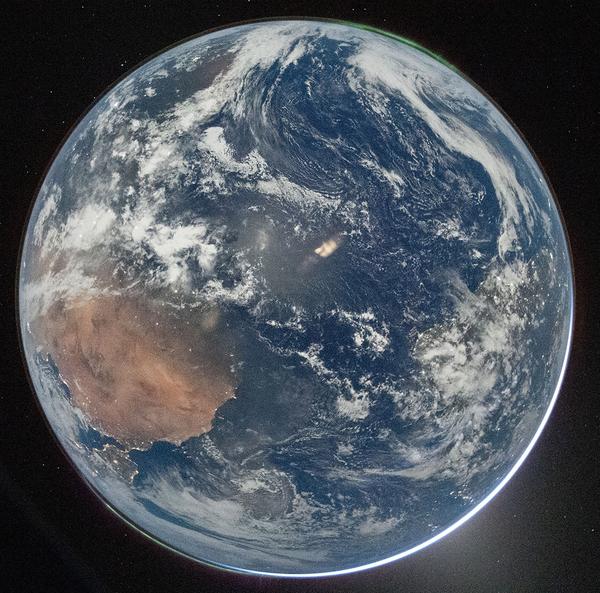
pic of the Full Earth, the first such image snapped by humans since 1972, really piqued my interest and helped reignite the cold embers of my excitement. I can't wait for an updated version of Earthrise, which literally rocked the world way back in '68. I wonder how people in 2026 feel about this event? Are young people inspired and fascinated as me and my contemporaries of 1968? Here's a
link to an edition of this newsletter from 2018 on the occasion of the 50th anniversary of that historic flight, including all my recollections of the experience. Here's links to two other Apollo-related newsletters from 2009, Recollections of Kennedy Space Center describing my three visits to KSC in 1969, 1995 and 2008, and Faith and the Bible in the Apollo Moon Program discussing some less-known Christian aspects relevant to Apollo and the Space Age,
downplayed in today's media. (The last two newsletters are in an outdated format and may not display well.) I've also noticed that the "Apollo deniers" have been very quiet since the Wednesday launch, at least anywhere I've seen. These people who disbelieved that trips to the Moon were possible in 1968 have had the luxury of time.
Naturally, they suppose, the grandparental generations of the past were such dumb yokels who would believe anything compared to the super-smart smartphone users of the 21st century, right? So whether or not the government and the media were lying to the public six decades ago, what answers do such skeptics have for Artemis in 2026? If this was impossible back then, is it still impossible today? Do I believe the government and the media lie to us, in 1968 and 2026? Yes, I do. Do I have any external, objective proof that NASA and Apollo actually went to the Moon in the 1960s and 70s, other than the fact that I watched it on TV? No, I don't. The current generation can see for themselves that going to the Moon is, at the very least, a media event, just like it was more than a half-century ago. So take it or
leave it. We all choose to believe what we want to believe, including mainstream narratives, whatever the actual truth might be. Today many Apollo deniers repeat claims that were popular in the 60s and 70s, citing various alleged scientific inconsistencies that are easily addressed. For example: no stars visible in Apollo photos; the orientations of
shadows on the Moon; the alleged dangers of passing through radiation in the Van Allen Belts, etc. Anyone willing to do homework with an open mind and willing to learn some scientific facts can understand the standard explanations. Otherwise, Apollo denialism is based on willful ignorance and nobody can help anyone with that. One question everyone should answer
for themselves is: do you believe that any sort of space flight is possible, and if not, why? Do Apollo deniers believe in satellites above the Earth that can be seen on any clear night? Do they believe that the Nazis bombed London with V2 rockets during WW2? Do they believe that ICBMs have existed since the Cold War that can deliver nukes to your
town? If they believe any of these things, do they disbelieve in human space flight? Why? Humans are just another payload for a rocket. How about the Space Shuttle or the ISS? Are those fake too, or just Apollo? And if you can fly a human astronaut to Earth orbit, why not that little extra boost to fly to the Moon? There is no physical reason why not. The modern Apollo denial movement was spawned in the mid-90s after the movie Apollo 13 which depicted the slide rules and dial indicators of the 1960s as low-tech tools used to accomplish space flight. Director Ron Howard visually communicated that comparatively crude methods were used for the Moon missions. Shortly afterwards in the 90s was a popular cable program that officially launched the current wave of Apollo denialism among young Gen Xers who
were not old enough to remember the 60s. The popular Apollo denial storyline posits that it would have been impossible to go to the Moon without computers. However, these folks are apparently unaware that the first modern microcomputer, the Apollo Guidance Computer (AGC) was developed specifically for the Apollo missions and was the genesis of the modern computer
renaissance. We wouldn't have today's computers had Apollo not gone to the Moon 50+ years ago. Chicken, meet egg. The AGC weighed 70 pounds and had less computing power than a 90s-era pocket calculator. Your phone is hundreds of thousands of times more powerful than the AGC. And the AGC was almost not enough to land on the Moon, as demonstrated by the "1202 alarm" that almost aborted the landing of Apollo 11, indicating that the data buffer was
overloaded. (Today's Artemis is very top-heavy with computer technology compared to Apollo. I pray that this does not pose a risk to the mission and its crew. Computers are very sensitive to the hard radiation environment of space. I also hope that it is not possible for America's enemies to hack these computers during the flight.) Unbeknownst to the current cadre, Apollo denialism was a big thing back in the day. There were many in those days who asserted that Apollo was "filmed in a movie studio." This scenario was depicted in the 1977 movie "Capricorn One" co-starring O.J. Simpson in happier times. People who made such claims
came off as cranky crackpots way back when. Are their contemporary counterparts appearing the same today? There were others in 1969 who did not disbelieve the space flights but used them to feed into the climate hysteria of that era. One would hear people contending that "the weather is all messed up ever since they started poking holes in the atmosphere
with those newfangled rockets! We never had such crazy weather when I was a young fella back in the 1920s!" This goes to show that, then as now, people will cite their fuzzy memories as anecdotal evidence to account for the fact that climate is constantly changing, subject to many variables, including cycles lasting for centuries. If you have any Apollo
denier friends, try to just ask them a lot of questions along the above lines. Meantime, let's look forward to more exciting news and images from Artemis and continue to pray for the safe return of the astronauts, and even greater excitement on future missions. And again, wishing your family a blessed Pascha! Till next time, God bless and clear skies, - jay The Ryan Family Cleveland, Ohio, USA When I consider thy heavens, the work of thy fingers, the moon and the stars, which thou hast ordained, what is man that
thou art mindful of him? and the son of man, that thou visitest him? - Psalm 8:3-4, a Psalm of David
|
|
|
|