This is the Classical Astronomy Update, an email newsletter especially for Christian homeschool families
(though everyone is welcome!) Please feel free to share this with any interested friends.
I will bless the Lord, who hath given me counsel: my reins also instruct me in the night seasons. -- Psalm
16:7 IN THIS UPDATE The Cleveland St. Paddy's Meteor of 2026 Lake Erie Ice - Followup Spring Skies Hi Friends, The seasons are like an annual miracle that we all take for granted. After an intense winter with cold temps and lots of snow, it's such a joy to see the landscape coming back to life. The Sun is shining bright and warm, dead grass is suddenly greening up, plants are sprouting, trees are budding. The coming months will see the land transformed as the trees leaf out and the plants come into full bloom. It really is an awesome world that the LORD has placed us upon. Don't take it for granted. I encourage everyone in this coming season to take the time to observe all the changes that accompany the annual variations in light and heat radiating from the Sun. The Heartland Self-Reliance Conference (THSRC) As mentioned before, I've been invited to participate in THSRC on May 15-16, 2026 in Millersburg, Ohio. I will be giving presentations on natural methods of telling time and finding direction from the Sun, Moon and stars. If you live in Ohio, or if you're of a mind to travel, please attend this conference, and spread the word to all your friends. Health Corner -- "The Sludging of Rural America" With the coming season of light and warmth, I'm looking forward to getting on an earlier schedule with the earlier sunrise, in the hopes of establishing a good circadian rhythm, as mentioned in previous newsletters. I've lately learned some astounding things about raw milk related to the sleep cycle. Long story short, raw milk is rich in healthy lactobaccillus bacteria which helps produce the neurotransmitter serotonin in the gut, which is a precursor to melatonin, which is the all-important sleep hormone. My sleep has been greatly improved since we've
found a regular source for raw milk. Still processing all this new info and might write more in the future. For now, I encourage you all to read this astounding article The Sludging of Rural America from the Brownstone Institute. Ever hear of "biosolids"? Raw sewage from urban sewer plants with the water removed, marketed as an agricultural fertilizer, but actually a toxic sludge including heavy metals and PFAS "forever chemicals" among other nasty ingredients. It's amazing how we're propagandized. As if our food supply is not toxic enough already. It's becoming very hard to be health conscious in modern America. The author is Paula Yockel of Mission 503. She is interviewed in this short video (3:39) from Children's Health Defense, Americans are being mass poisoned by something that no one is talking about, part of a longer interview with Polly Tommey. Paula is apparently a Christian as indicated by the Bible verses and vernacular on her site. I'm not sure
what can be done about this problem. Sounds like the train has already left the station. But it's always useful to be informed. For our part, we'll soon be getting our own chickens and turning most of our backyard into a garden for 2026, in the hopes of having at least partial control over our own food supply. For more information about topics from Classical Astronomy discussed in this newsletter, please check out a homeschool astronomy curriculum (but popular with adult readers too!) Visit our archive of previous editions of the Classical Astronomy Update newsletters, going back to
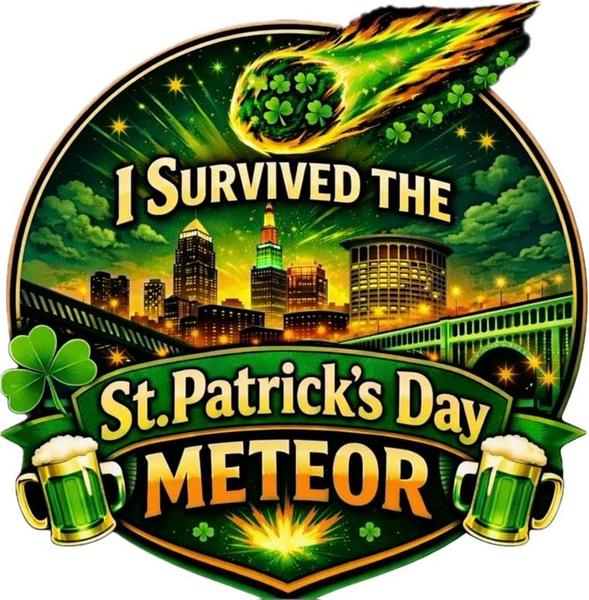
2007. SOCIAL MEDIA ***** The Cleveland St. Paddy's Day Meteor of 2026 Perhaps you saw the news this week that my hometown of Cleveland experienced a daytime bolide, an exploding meteor. This event has
been greeted with great fanfare, locally and abroad, probably due to the timing of St. Patrick's Day. The annual parade is a big event here in Cleveland, and is often accompanied by nasty late winter weather, which usually
results in sarcastic, cynical humor about our local climate. But nonetheless, a festive, light-hearted vibe always prevails in Cleveland on St. Paddy's Day and this meteor rolled right into that. I gather from all reports that the meteor was highly visible and seen by many people. The explosion was accompanied by a very loud BOOM when this cosmic firecracker went off about 9:00 AM. Dogs were apparently barking all over town and many reported their houses and windows were shaken.
One business owner claimed it blew out a window at his shop. Here's an excellent compilation video from the TODAY show of reports and interviews with Cleveland meteor eyewitnesses (and
earwitnesses), including the now-infamous potty-mouth motorist who caught it on his dashcam. Since then the local news has been filled with stories of meteor hunters pouring in from far and wide to comb over the scatter zone looking for chunks of space debris. My phone and email inbox were lighting up all that day with queries of "DID YOU SEE IT? DID YOU HEAR
IT?" After all, I'm the friendly neighborhood astro-space-science dweeb, so I have a civic obligation to witness every such event and be the know-it-all Shell Answer Man to provide detailed information for answering everyone's questions. But sadly, no, the luck of the Irish was not with me that morning, even though I was outside about that time. I hear
so much stuff day and night from my noise-polluted urban location, including trains, planes, automobiles, sirens and all the other numerous sounds of the city. So I tend to tune out extraneous sounds, even though this one was apparently hard to miss. At church, Backyard Bob regaled me with his story about how the boom rattled his house, as if a heavy load was dropped on his front porch. Many of his neighbors heard it too and thought something big happened at a nearby industrial
park up the hill. So people living on all sides around me heard the boom, 20-30 miles from the blast site, but it somehow sailed right past my ears. I first heard of the story in a text thread with my friends David from NASA, who I worked with promoting the Eclipse Over Cleveland two years ago, and also JP, who cuts a figure around town as "The Cranky Arborist™." These dudes both heard the boom and I didn't. These two also saw the aurora events in 2024 and 2025 from Lakewood Park, which I skipped for some dumb reason. I should
hang out more with these guys so that I don't miss any more of this cool astro-space-science stuff that I always get quizzed about! I once saw a daytime bolide in the late 80s while living in the Washington DC area, round about sunset when I was walking home from work. It was very cool but it was a non-story, never heard a peep in the media. My family
witnessed a spectacular fireball after I gave an outdoor program at Faith Ranch in 2013. This was captured on film by Angela, an Update reader, and was the subject of a local news story, as reported in this newsletter at the time.
Such bolides are very common, probably a dozen or more every day over Planet Earth. But the Earth's surface is 70% water and most go unobserved over the oceans. Of those that do pass over land, most are over uninhabited areas, including Antarctica and the Sahara Desert and such. It's rather uncommon to have a bolide visible over major metropolitan areas,
which comprise a small area of the globe. The Cleveland bolide was just a cute little guy, only exploding with the force of a mere 250 tons of TNT and making a tiny little boom noise that mostly scared dogs. A larger, more spectacular (and more destructive) bolide exploded over Chelyabinsk in Russia in 2013, appearing as bright as the Sun, exploding with the force of a nuclear blast, damaging buildings and injuring over 1000 people, mostly from shards of broken glass. The even more powerful,
more destructive Tunguska meteor exploded in an uninhabited area of Siberia in 1908, flattening trees in a pattern radiating away from the blast site. The real science know-it-all experts tell us that it's only a matter of time before a catastrophic meteor hits the Earth with devasting consequences. I've always believed that such an event is prophesied in
Scripture.... And the second angel sounded, and as it were a great mountain burning with fire was cast into the sea: and the third part of the sea became blood; And the third part of the creatures which were in the sea, and had life, died; and the third part of the ships were destroyed. -- Revelation 8:8-9 Sounds to me like a solid Biblical description of a meteor strike. This Scripture fits with the above fact of the Earth's surface area being 70% ocean, which was not known in Bible times. However, I've never gotten much traction with this interpretation, either from secular science or theology types, who have both assured me that that's not what that passage means. What do I know, I'm just the
friendly neighborhood astro-space-science dweeb. Whatever that verse really means, we'll all find out someday. The timing of the Cleveland St. Paddy's Day Meteor of 2026 also coincided with some strange weather and other peculiar occurrences in Ohio, including tornadoes, a small earthquake and purported Bigfoot sightings. We had violent wind storms last week,
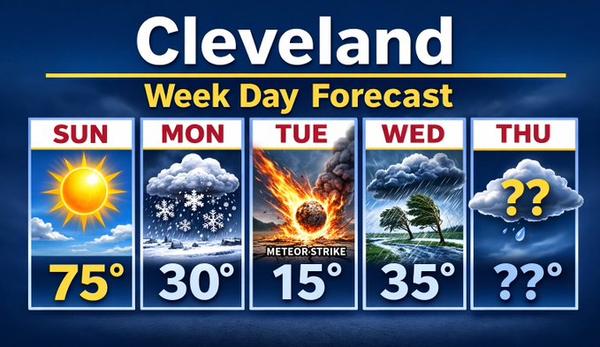
and last Sunday was a record-breaking unseasonably hot day, officially 77 degrees, though my car thermometer clocked in at 80. The temps plummeted the very next day and we actually had snow on Monday! And then this meteor happened on Tuesday! This meme popped up on social media. What a week! My buddy Tony texted me this meme below of what REALLY happened in Cleveland on the morning of March 17, perhaps in commemoration of last summer's Superman movie filmed here. I especially liked this, me being a Superman nerd since my early childhood in 1966. But if Baby Kal-El's ship did land in Cleveland, he'd be
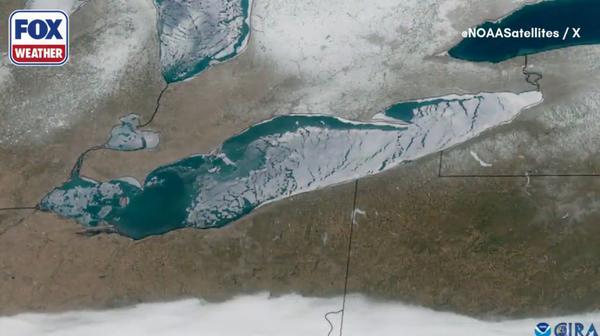
adopted by the Kentkowskis! Lake Erie Ice - Followup One aspect of seasonal change that I find fascinating is the accumulation and recession of ice atop Lake Erie. As reported
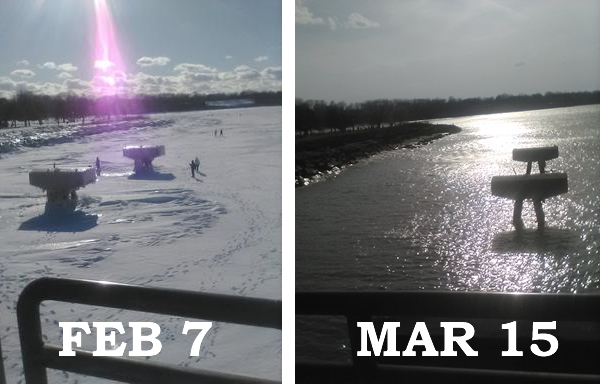
last time, the lake was 96% frozen in February, 2026, the first time in 30 years. We then had a run of warm weather and the ice retreated quickly. Here's the satellite view on March 10: I went down to the lakeshore on that 77 degree day last Sunday and you'd've never known that that lake surface was solid ice only 5 weeks before. What an amazingly beautiful and ever-changing world the LORD hath made! Spring Skies As mentioned recently, this newsletter will emphasize aspects of telling time and navigation from the Sun,
Moon and stars, a time-honored practical application of Classical Astronomy. These techniques had been known and practiced down through all pre-industrial history in all cultures across the globe, but in our modern hi-tech generation, these methods are forgotten. As the world spirala along toward uncertainty, it would be very wise for people to rediscover the practical utilitarian value in observing these celestial cycles. With this edition, I hope to begin a year-long seasonal survey of the sky to help you learn to observe the daily cycle of the constellations, and how they change throughout the seasons with the cycles of the Sun and Moon. This subject matter will be included in my presentation to THSRC this May. As a preliminary, here's a brief summary of foundational topics known to readers of our Signs &
Seasons curriculum. Summary The stars of the sky appear to lie along a great celestial sphere. The sphere is just an illusion since our eyes cannot perceive the unfathomable distances to
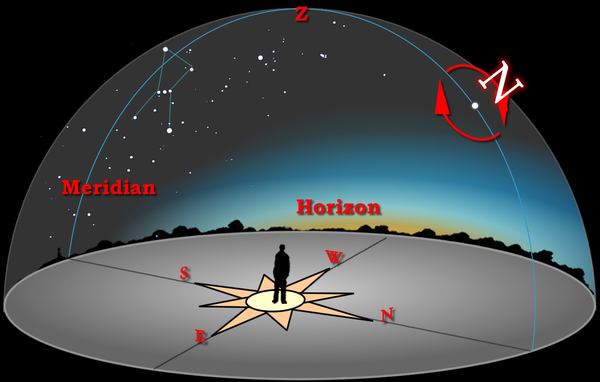
the stars, so they simply appear to be an equal distance away from our eyes, and a sphere is defined as a geometrical object in which the surface points are equally distant from a center point. Since the sky appears spherical, we can envision four useful circles inscribed along the celestial sphere. The first circle is the horizon, which divides the visible
portion of the sky overhead from an invisible portion of the sky below ground level, so that the sky overhead appears as a hemispherical dome (i.e., "the firmament.) The celestial sphere appears to rotate each day with the rotation of the Earth so that unseen celestial objects appear when they rise above the horizon and disappear when they set below the horizon. The second circle is the meridian, which is perpendicular to the horizon and extends overhead through the zenith Z and the north celestial pole N. The meridian represents the place in the sky where the Sun, Moon, stars and planets reach their highest elevation, the midpoint between rising and setting. The meridian intersects the horizon at due north and due south. In the northern hemisphere, the Sun, Moon and planets
cross the meridian when they are above due south. So the meridian can also be used to find direction. The spherical sky is like a mirror of the spherical Earth, celestial features corresponding to terrestrial counterparts. Just as our terrestrial globe has North and South Poles and an Equator, the celestial sphere includes celestial north and south poles and also a celestial equator. The celestial equator is the third
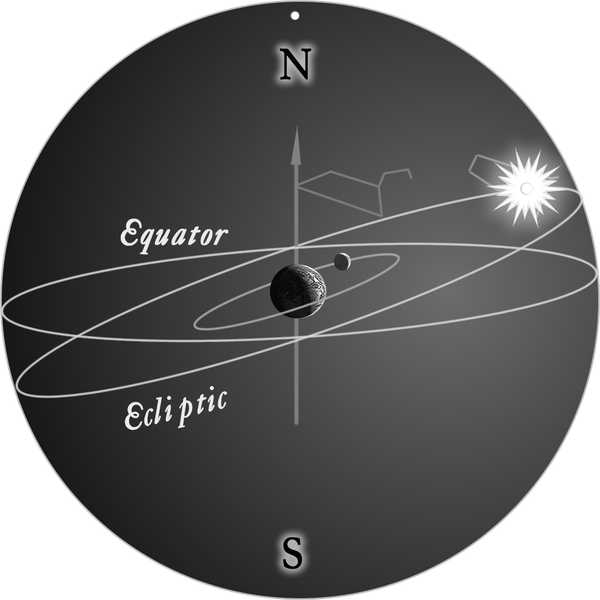
circle of the celestial sphere needed for this lesson, which defines the middle distance in the sky between the celestial poles. The celestial equator intersects the horizon at due east and due west, and can thus also be used to find direction. The fourth circle of the celestial sphere is the ecliptic, which corresponds to the plane of the solar
system. The ecliptic is the path in the sky through which the Sun, Moon and planets appear to follow over the courses of their cycles. The ecliptic is the oblique circle, and is inclined 23-1/2 degrees to the celestial equator, corresponding to the obliquity of the Earth's axis to the plane of the solar system. The ecliptic therefore has northern and southern extremes, points along the circle which are respectively closest
to the north and south celestial poles. These two points are called the solstices. The ecliptic intersects the celestial sphere in two points, which are called the equinoxes. (This is the end of the brief summary, though there's way more to understand and appreciate. For a more detailed lesson, check out S&S.) Spring Skies The solstices and equinoxes are collectively known as the seasonal cardinal points. We can conveniently divide the celestial sphere into four quadrants, where each quadrant is associated with one of the seasonal cardinal points. Each day, as the Earth
rotates through each 24 hour daily cycle, all the celestial bodies -- the Sun, Moon, stars and planets -- all cross the meridian. Same with the four quadrants of the celestial sphere along with the seasonal cardinals. But we don't see the stars and planets during the daytime as they are hidden behind the bright sunny blue sky, and the Moon is inconspicuous. But whether or not they are visible, these celestial objects are still above the horizon, invisible as long as the Sun is
also above the horizon. So each of the four quadrants pass the meridian six hours apart (because 4 x 6 = 24, QED). If one quadrant and its seasonal cardinal point is at the meridian, the next one will pass the meridian 6 hours later, and the following quadrant 6 hours after that (12 hours total) and the fourth quadrant another 6 hours thereafter (18 hours
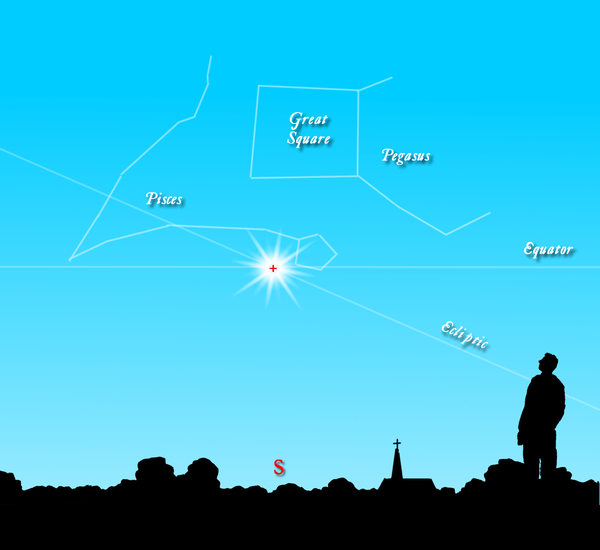
total) so that the whole cycle of quadrants repeats after 24 hours. The following images all show the four quadrants 6 hours apart as they would appear on March 20, the first day of spring. The sky will still have this same general appearance for the next week or two, even though the Sun will have moved several degrees toward the east. * * * * * At "high noon" on the first day of spring, the Sun is at the meridian at the vernal equinox, the point of intersection of the ecliptic with the celestial equator aligned with the constellation
Pisces. This part of the sky includes the constellation Pegasus, visible at midnight on the first day of autumn, when the Sun is on the opposite side of the celestial sphere. Spring began at 10:46 PM on March 20, the precise moment the Sun was at the point of the vernal equinox, centered on the celestial equator. The day when the Sun crosses the equator in the spring is also called the vernal equinox (from the Latin vernalis, meaning "spring"). The
word equinox means "equal night," and these are the days of the year when the Sun is traditionally understood to spend equal 12 hour intervals above and below the horizon. This first quadrant of the celestial sphere is The Pegasus Sky. If the stars were visible through the blue sky, one would see The Great Square of Pegasus high overhead when the
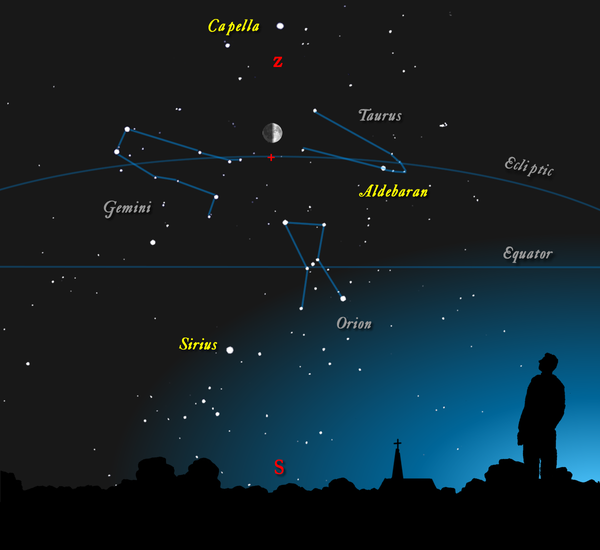
Sun passed the meridian. By 6:00 PM, six hours after the Sun crosses the meridian at the point of the vernal equinox, the point of the summer solstice has rotated to the meridian. This point is the northernmost point of the ecliptic, representing the northernmost extreme of the Sun in the noon sky, which happens on
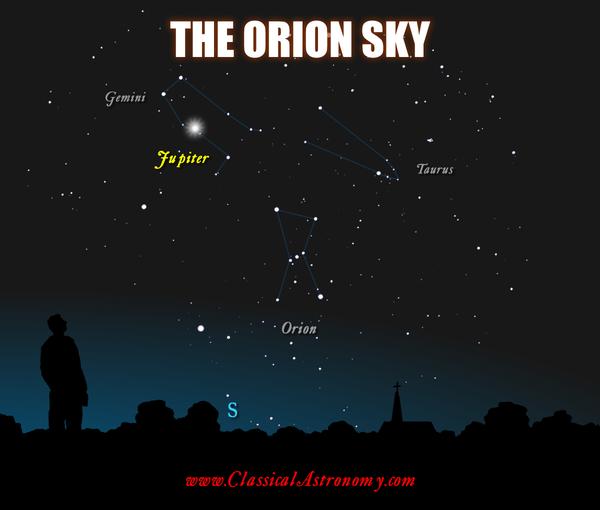
the day of the summer solstice, June 21, the longest day of the year and the first day of summer. The Sun will reach this point in another three months but for now it's visible in the evening after sunset. The summer solstice point is in the constellation Gemini, which is in The Orion Sky, the second quadrant of the celestial
sphere, to the east of The Pegasus Sky. The solstice point crosses the meridian at sunset, but the starry view shown below becomes visible in the fading dusk n less than hour after sunset, before "the twilight's last gleaming." In this way, the evening sky after sunset shows the location of the Sun in the coming months. Our old friend Orion is still dominating the evening sky, and will sink toward the sunset through April in May, as the Sun's position advances to the east. Orion shares the sky with his loyal dog Sirius, along with Taurus and its brightest star
Aldebaran lying along the ecliptic, while the bright star Capella is overhead near the zenith as seen from North America. The waxing Moon will pass near the summer solstice point at First Quarter on Wednesday, March 25, a half-moon hanging high in the northern sky. I always call this configuration of a First Quarter above
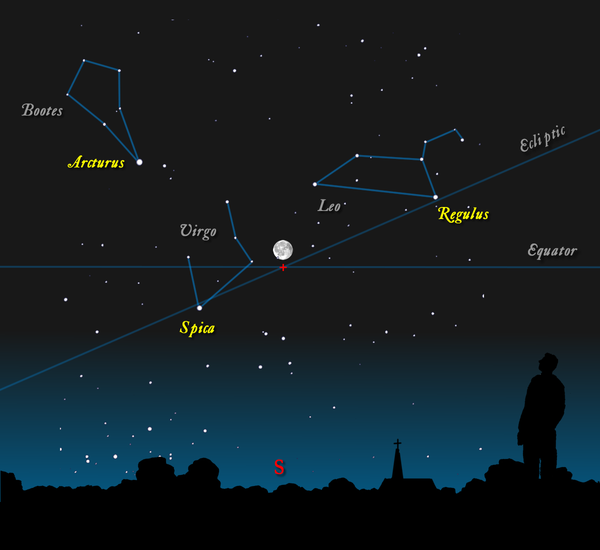
Orion the "Baby Dave Moon" since this was the sky overhead on the night we brought our eldest son David home from the hospital in 1994. Though this phase occurs on a different date each year due to the cycle of the Moon, this seasonal alignment is as sure a "sign" of spring as the warmer temps and sprouting plants. * * * * * After another six hours of rotation, The Virgo Sky rolls to the meridian at midnight on the first day of spring. This is the third quadrant of the celestial sphere in succession. The constellation Virgo includes the place of the autumnal equinox, the other intersection of the ecliptic with the celestial equator, the opposite point in
the sky from the vernal equinox, where the Sun aligns on the first day of fall in September. Virgo is distinguished by the bright star Spica, lying along the ecliptic. To the north above is the constellation Bootes (pronounced "bo-oo-tease") with its bright star Arcturus. To the west is the constellation Leo with its bright star Regulus, also along the ecliptic. The Full Moon is always opposite the Sun. So the first Full Moon of spring is always in Virgo, close to the point of the autumnal equinox. This is the Paschal Moon, signifying Passover (the Hebrew "Pesach") according to Exodus 12, which this year falls on the evening of
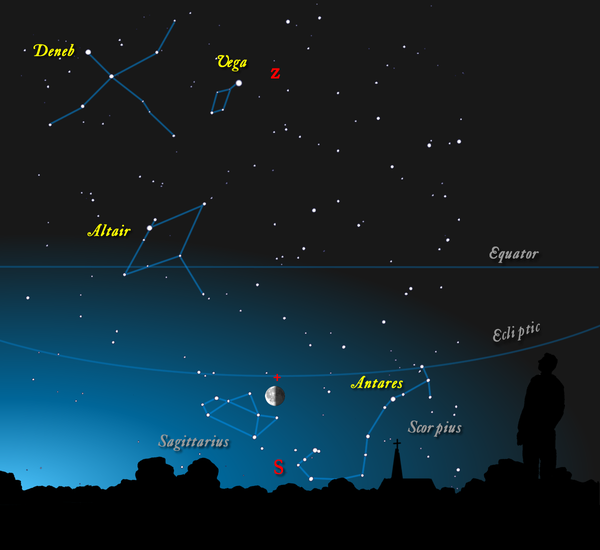
Tuesday, April 1. According to the rules adopted at the Council of Nicaea in A.D. 325, Easter (or Pascha) falls on the first Sunday after the first Full Moon following the vernal equinox, which, in 2026, occurs on Sunday, April 6. * * * * * By 6:00 AM, six hours after midnight, the fourth and final quadrant of the celestial sphere has rolled to the meridian. This is The Summer Triangle Sky, the constellations that are readily visible in the evenings of late summer and fall. This quadrant includes the constellation Sagittarius, which hosts the winter solstice, the southernmost point on the ecliptic, lying low to the southern horizon as viewed from
the northern hemisphere, where the Sun was on the shortest day of the year back in December. In this manner, the morning sky shows the the place of the Sun in the season that has just departed Sagittarius shares the southern sky with the constellation Scorpius, featuring the bright ecliptic star Antares. High up overhead is the Summer Triangle, an asterism of bright stars near the zenith including Deneb, Vega and Altair. If you're up
before sunrise in the next week or so, look for these stars before "the dawn's early light." Follow the waning Moon through this quadrant in the morning sky through the month of April. Look for the Last Quarter Moon near the winter solstice point on the morning of Tuesday, April 10, and then through the waning crescent phases that vanish into the
sunrise. * * * * * I intend to use the above progression to explain how the Sun and Moon roll through the four quadrants of the celestial sphere over the span of the seasons. I'm hoping this will be a logical presentation to help everyone learn the constellations and better recognize
the "signs in the heavens" that help identify the seasons, as had been understood by the Old Farmers who read the Colonial Almanacks in Early America. Let me know if you find this description helpful, I'd be grateful for the feedback. Meantime, I encourage you all to take your last looks at The Orion Sky in the early evenings of the coming month before this
quadrant disappears into the sunset, especially the blazing bright planet Jupiter passing through Gemini. Look for the waxing gibbous Moon to pass Jupiter this week on the evening of Thursday, March 26. Till next time, God bless and clear skies, - jay The Ryan Family Cleveland, Ohio, USA When I consider thy heavens, the work of thy fingers, the moon and the stars, which thou hast ordained, what is man that
thou art mindful of him? and the son of man, that thou visitest him? - Psalm 8:3-4, a Psalm of David
|
|
|
|