This is the Classical Astronomy Update, an email newsletter especially for Christian homeschool families
(though everyone is welcome!) Please feel free to share this with any interested friends.
From the rising of the sun unto the going down of the same the Lord's name is to be praised. -- Psalm 113:3 IN THIS UPDATE Orion in the Evening Permanent Standard Time The Analemma Hi Friends, Hope you had a wonderful Thanksgiving and are enjoying the changing seasons in your area. We've had
cold, windy weather in Cleveland and got clobbered with a half-foot of snow by Thanksgiving dinner time. Some people complain about it but I enjoy all types of weather, from sunny and mild to the temperamental extremes. I went to Edgewater Park in the storm where I always observe sunsets all summer. The winds were lashing cold and hard, whipping up 3-5 foot waves on Lake Erie. I was there during Superstorm Sandy in 2012 with 15 foot waves crashing on the breakwall. It's
all very dramatic. So I went out onto the pier which was shaking from the vibration of the waves and passed a surprising number of other weather thrillseekers. Devout Clevelanders love this sort of weather punishment, and you'll always catch them at Edgewater on blustery winter days. I exchanged friendly greetings with passersby
over the howl of the wind, sarcastic understatements like, "It's a bit breezy today," and received Cleveland snark in reply, "Yeah, just a bit." Whether or not you enjoy the extremes, weather of all types is a glorious thing, and the churning of the atmosphere testifies to the awesome power of the LORD. Health Corner -- Seed
Oils My understanding continues to grow about healthy eating and the toxicity of the faux consumables peddled by the "food" industry. A recent newsletter mentioned about the horrors of cottonseed oil. Since then I learned that people in olden days used products made from animal fat as cooking oils -- lard, beef tallow and butter which are actually more heart-healthy, contrary to popular belief. But animal fat has poor shelf life and is not usable for
packaged foods. Seed oils were substituted mainly for being more shelf-stable, though they are horrendous from a health standpoint. Seed oils are made by crushing and squeezing seeds under high pressure and temperature to extract the oils, conditions that do not exist in nature. This destroys the naturally-occurring long chain omega 3
fatty acids, the "healthy omegas," resulting in short chain fatty acids that cause formaldehyde to build up in the body. There was a big marketing push a century ago by the food industry to promote seed oil products and demonize animal fat. I'm still learning and understanding this new and unfamiliar subject, but long story short, science shows that the natural whole foods that the LORD created and called "good" are what we should be eating, and the man-made products of industrial
processes are destroying our health. * * * * * I've been greatly blessed by podcasts including American Thought Leaders. Here's a recent 22 minute interview with Charles Murray, author of the controversial book, The Bell Curve, describing how he came to faith as a secular scientist. His story is reminiscent of C.S. Lewis who arrived at the conclusion of faith from rational thinking. Here's another, an astounding 45 minute interview with James Tour, a research chemist, explaining his method of Fast Joule Heating (FJH). The interview is rather technical, but his method
purports to solve America's rare earth dependence on China while simultaneously solving the computer waste dilemma. The FJH method has very low energy consumption and also has promise for remediating pollution including destroying PFAS, "forever chemicals" like Teflon. This is a really exciting development, almost a technological miracle. I was even more excited to follow Dr. Tour's TwiX page and discover that he is a devoted Christian with an amazing personal testimony of his faith in Jesus.
Dr. Tour describes a transformative (i.e., emotional) encounter with Jesus, unlike Dr. Murray's rational process. It goes to show that the LORD does not have a "one size fits all" path to faith and can reach people wherever they are, in ways that are special for each individual. The LORD is raising up so many of His people to shine His light in this present dark time, it's very encouraging. * * * * * Thanks to everyone who recently ordered a copy of our Moonfinder storybook. There's still time to order a copy for Christmas. Give the gift of understanding the phases of the Moon to the little kids in your life! For more information about topics from Classical Astronomy discussed in this newsletter, please check out a homeschool astronomy curriculum (but popular with adult readers too!) Visit our archive of previous editions of the Classical Astronomy Update newsletters, going back to
2007. SOCIAL MEDIA ***** Orion in the Evening One thing I'm always thankful for around Thanksgiving is that the seasonal wheel has turned so that the constellation Orion is again visible in the evening sky. If you go outside some clear
evening this month around 9:00 PM and look to the east, you can see Orion coming up above the horizon, laying on his side, becoming vertically upright as he approaches the meridian after midnight. As longtime readers will recall, Orion is the reason for Classical Astronomy. I first met this starry friend as a 7 year old in the winter of 1969. My second grade
teacher, Mrs. Tintera, showed us kids a picture of Orion and explained how to spot him in the sky. I was hooked. Every winter for the last 57 years I've loved seeing my old friend in the evening sky. As my friend Dr. Parsons said, "I get excited every time I see Orion. Every time." My sentiments exactly. Orion is named in three
Scriptures. I've asked Mrs. Ryan to inscribe this verse on my tombstone: Seek him that maketh the seven stars and Orion... The Lord is his name. - Amos 5:8 According to modern science, there's no such thing as Orion. The
constellations do not really exist as we see them, but are only just optical illusions, mere alignments of variably distant stars as they appear from the line of sight of Earth. I don't care what the experts say, I believe in Orion, do you? You won't be able to miss the blazingly brilliant planet Jupiter currently passing through Gemini and rising with
Orion. Jupiter will be at opposition on January 10 when it will rise at sunset and only be visible in the evening sky until disappearing into the sunset next summer Permanent Standard Time Early this month during "fall back" to standard time from daylight savings, the perennial battle raged online about how to handle the issue. Many people today
agree that they hate all the seasonal clock changing and want to keep the clocks set year round. But people are divided over whether it should be permanent standard time or permanent daylight savings. The issue boils down to the time of sunrise, whether the Sun comes up too early in the summer (daylight before people are accustomed to rise) or too late in the
winter (darkness during the morning commute). But it was because of this dilemma that the issue of clock switching was established in the first place. So I posted this graphic on TwiX to help people
visualize the choice. We can either adopt one or the other or stick with the present clock switching. Some people will be unhappy in any event. The Analemma Lately I've been transitioning Classical Astronomy away from the "what's up in the sky" approach to emphasizing natural methods of timekeeping from the Sun, Moon and stars.
This article picks up a thread from a couple newsletters ago, Up and Down the Seasonal Hill, how the annual apparent
motion of the Sun along the ecliptic is in the pattern of a sine wave. From this, the pattern of variable daylight is also sinusoidal, changing rapidly around the equinoxes and leveling out and remaining almost constant for a month or so on either side of the solstices. In the current period from late November through late January the Sun is in the
"valley" of the seasonal hill, the southernmost declinations of the ecliptic. Here in Cleveland, around latitude 40 degrees north, the duration of daylight is about 9 hours and 39 minutes on November 21, 9 hours and 10 minutes on December 21, the winter solstice, and back up to 9 hours and 42 minutes on January 21. So the total hours of daylight only vary about a half hour over this two month period, compared to a three hour variation over a similar span
around the equinoxes. Daylight is shorter for latitudes north of 40 and longer for more southerly latitudes. Though the duration of daylight tends to change smoothly over the seasons like a sine wave, the actual times of sunrise and sunset have a bit of a twist. For reasons that will (hopefully) become clear, the earliest sunset of the year takes place in early December, a few weeks before
the shortest day. And then the latest sunset of each year occurs in early January, a couple weeks after the shortest day. (Got that? I know, right? Wobbity wobitty wobbity. Buckle up friends, we're about to get into some of the deep weeds of astronomy!) Each year the Sun moves north to south over the seasons, measured as changing declination, the coordinate system of the sky, the counterpart of latitude on the Earth. On the equinoxes, the Sun is at the celestial equator, declination zero. Following its path along the ecliptic, the Sun heads north in declination over the spring, reaching a declination of 23.5 degrees north on the summer solstice. The Sun
then moves south along the ecliptic for 6 months, reaching a declination of 23.5 degrees south on the winter solstice. (The ecliptic and the celestial equator are explained in detail in our Signs & Seasons curriculum.) In observing the annual seasonal motion of the Sun across the declinations of the sky, you might have thought that it would oscillate back and forth evenly
between north and south like a celestial pendulum. If only it was that easy! Instead, the Sun traces out a figure-8 pattern as it moves from north to south. This figure-8 is called the analemma. With Classical Astronomy, every time you think you're getting a handle on a new concept, there's always more! The analemma is a good
example. We're accustomed to mechanical and electronic clocks in which time the time of day is divided into neat and precise units of hours, minutes and seconds that recur every 24 hours. By that reasoning, the Sun ought to arrive at the meridian every day at noon, local time. But in reality, thanks to the analemma, there are some weeks and months of the
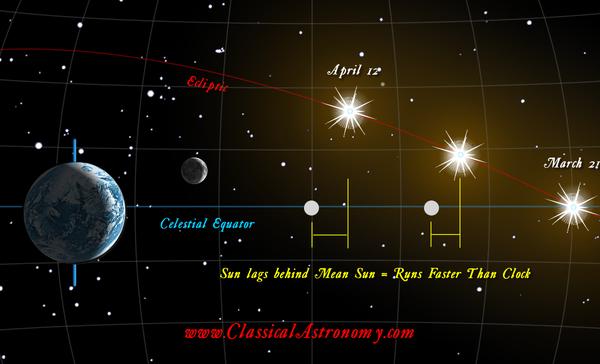
year when the Sun runs fast compared to the clocks and arrives at the meridian a few minutes before noon, in the A.M. part of the day. There are other weeks and months of the year when the Sun runs slow compared to the clocks and arrives at the meridian after noon, in the P.M. part of the day. This apparent anomaly happens because of the eccentricity of the Earth's orbit and the 23.5 degree obliquity of the Earth's axis. These factors each contribute components that add together to produce the analemma. The actual position of the Sun is compared to the mean sun, a
theoretical ideally uniform motion of the Sun as if it moved at a constant rate along the celestial equator. The difference between the mean sun and the actual Sun is called the equation of time, which is the sum total of these two components for any date of the year, as shown the following graph. So basically, as the Sun changes in declination, there are corresponding changes in the equation of time. The graph above shows the analemma as the equation of time plotted out for each declination. The equation of time is also called "sundial error" since it shows the difference between the
clock and the sundial. But in Colonial America, when sundials were more common, the equation of time was called "clock error." It's all in your perpective. The equation of time must also be taken into account for celestial navigation, and has been giving fits to sailors for a very long time.... The difference between the sun’s position and the position where the sun ought to be if it were a decent, self-respecting sun, man calls the Equation of Time. – Jack London, from Voyage of the Snark (A.D. 1911) The eccentricity component is the result of the Earth speeding up in its orbital
motion as it approaches perihelion, its closest position to the Sun. This is due to Kepler's Laws of Motion, which are the basis of Newton's Law of Universal Gravitation. Essentially, due to gravity, the Earth (or any planet) moves faster when it's closest to the Sun. As a result, the Sun appears at a point on the ecliptic ahead of the mean sun, where it would appear if its motion were constant like a clock. The Earth passes perihelion on January 3, when its declination is about 23 degrees south, as shown in the graph above. The Sun's position runs progressively faster as the Earth approaches perihelion and remains ahead of the mean sun until the Earth'sorbital motion slows with the approach to
aphelion, its most distant point from the Sun, round about July 4, near 23 degrees north as shown in the graph above. At that time the Sun runs slow and the eccentricity component of the equation of time now lags behind the mean sun. The obliquity component is due to the tilt of the Earth's axis and its north and south poles toward the ecliptic
which causes the seasons. For this reason, the Sun's path along the ecliptic appears tilted to the celestial equator, which is referenced to the Earth's axis. Because of obliquity, the Sun runs slower than the mean sun around the equinoxes and faster around the solstices. In the example of the vernal equinox, the Sun's ecliptic path is tilted to the celestial equator in early spring, so the Sun's path has a horizontal component toward the east and a vertical component toward the north while the mean sun only has a horizontal component toward the east. This results in
a lag of the actual Sun, so that it reaches the meridian earlier than the mean sun, therefore running faster than the clock. However, by later spring, approaching the solstice, the Sun's ecliptic path levels off, becoming more horizontal. Now here's another twist -- with the higher declination, the intersecting circles of right ascension are closer together, just like how the terrestrial circles of longitude converge toward the poles. So the
Sun moves more quickly through right ascension and thus catches up to the mean sun. (Don't worry if these new concepts are hard to follow, we're almost to the punchline.) So anyway, due to obliquity, during the spring the equation of time forms the upper right section of the figure-8 in the graph above when the Sun moves faster than the clock. A reverse process happens in the summer, forming the upper left section in the graph above where the Sun is slower than the
clock. The lower right section represents fall and the lower left corresponds to winter. And the combined components of the equation of time for both eccentricity and obliquity are represented in the final combined analemma on the right of the graph above. So who cares anyway? Why do we need to know this? Because the equation of time and the
analemma affect the time of sunrise and sunset, which is especially significant here in the shortest days of the year. During December, the days are growing shorter but the Sun is running ahead of the clock, arriving at the meridian and then at the sunset horizon a little sooner than we might expect. As seen from Cleveland, the sunset is the earliest of the year on December 8, at 4:56 PM, varying by mere seconds for several days before and after. Here's the tricky part. The Sun sets at 5:00 PM on November 23 and sets only a few minutes earlier each day until December 8, and gets back to 5:00 PM again on December 21. So the sunset time is fairly constant for nearly a month. But the shortening of the daylight appears in the
sunrise, which varies by 24 minutes during over this one-month period. Here's a table of select sunrise/sunset times for Cleveland from the Time and Date site: Date Sunrise Sunset Nov 23 7:25 AM 5:00 PM
Dec 1 7:34 AM 4:57 PM
Dec 8 7:40 AM 4:56 PM
Dec 15 7:41 AM 4:56 PM
Dec 21 7:49 AM 5:00 PM And as you can see from the table above, the time of sunrise occurs later and later as the shortest day approaches. This trend continues for a couple weeks after the shortest day. After the winter solstice, the equation of time runs slow through late December and into January. Thus, the Sun rises later than one would expect and also reaches the meridian later. In Cleveland, the date of the latest sunrise is January 3, when the Sun rises at 7:53
AM. Just as the times of sunset are close for nearly a month before the winter solstice, similarly the times of sunrise remain nearly constant for nearly a month after the solstice, while the times of sunset extend later as the duration of daylight lengthens: Date Sunrise Sunset Dec 21 7:49 AM 5:00 PM
Dec 28 7:52 AM 5:04 PM
Jan 3 7:53 AM 5:09 PM
Jan 10 7:52 AM 5:16 PM
Jan 16 7:50 AM 5:23 PM This process continues with the sunrise arriving earlier and the sunset occurring later until the longest days around the summer solstice in June. These are just the times for Cleveland but similarly late sunrises and early sunsets will occur at different times for different locations,
depending on your longitude and latitude. Generally speaking, the earliest sunset arrives at an earlier date in more southerly latitudes (Nov. 29-Dec. 3 in Florida and South Texas) and at a later date in more northerly latitides (Dec. 9-12 along the US-Canada border). Visit the Time and Date site to find the times for your city. But more importantly, make it a point to be outside around these times in the coming month to observe the changes directly. It's really an interesting phemonenon, hiding in plain sight for anyone who will look. This will be the last newsletter for 2025 as I plan to create presentations for the speaking gig next May, and then to resume work on the book. Your prayers would be appreciated as I contemplate a big change in my life ('nuff said for now). My family and I wish you and your family a very blessed and Merry Christmas and a prosperous and purposeful New Year in 2026! Till next time, God bless and clear skies, - jay The Ryan
Family Cleveland, Ohio, USA When I consider thy
heavens, the work of thy fingers, the moon and the stars, which thou hast ordained, what is man that thou art mindful of him? and the son of man, that thou visitest him? - Psalm 8:3-4, a Psalm of David
|
|
|
|